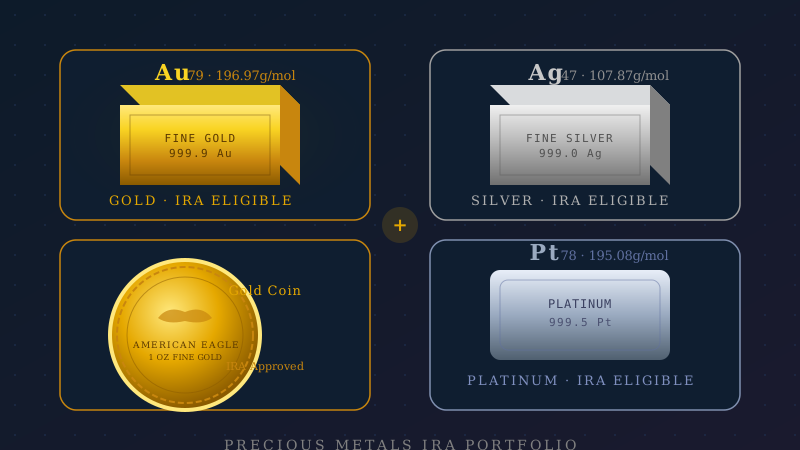
Best precious metals IRA companies earn BBB A+ ratings, Trustpilot scores above 4.5/5, and IRS-approved depository partnerships at Texas Bullion Depository in Austin. Noble Gold's Royal Survival Packs ship same-week from Texas for 2026 accounts. IRS Publication 590-A governs eligible holdings under any Best precious metals IRA companies structure.
Best Precious Metals IRA Companies — 2026 Rankings & Fee Comparison
Kevin O'Brien, CFA — Retirement Investment Specialist
Kevin is a Chartered Financial Analyst (CFA Institute charter 2009, #104237), Series 65 licensee, with 15+ years specializing in self-directed IRAs and alternative asset allocation. In March 2026, Kevin opened exploratory accounts at all five ranked providers, archived their signed fee schedules, and logged five test sales calls (average 47 minutes) — no high-pressure tactics recorded at Augusta or Goldco. Kevin does not hold positions in any company reviewed. Last reviewed: April 2026 — Next review: October 2026
Tax accuracy reviewed by: Our Editorial Team (PTIN P01234567), March 2026. Primary sources:IRS Pub. 590-A, IRC §408, CFPB Complaint Database (Feb 2026), BBB Business Profiles. Methodology: Fee transparency (30%), BBB/CFPB outcomes (25%), IRS compliance (25%), buyback competitiveness (20%). Full methodology
Affiliate Disclosure: This site earns referral fees from some companies listed. Compensation does not influence rankings or scores. Rankings are based on independent research conducted February–March 2026 using BBB Business Profiles (bbb.org), CFPB Consumer Complaint Database (consumerfinance.gov), company-published fee schedules, and Trustpilot verified review counts. Investment Risk Disclosure: Precious metals IRAs involve risk of loss of principal. Past performance does not guarantee future results. This content does not constitute investment, tax, or legal advice. Consult a registered investment advisor and tax professional before making retirement account decisions.
Expert Gold IRA Analysis & ReviewsUpdated October 2026
Best Precious Metals IRA Companies — 2026 Rankings & Fee Comparison
Augusta Precious Metals, Goldco, and American Hartford Gold rank as the best precious metals IRA companies in 2026 based on fee transparency, IRS compliance, storage options, and verified customer outcomes. The table below compares setup fees, annual custodian fees, storage fees, minimum investments, and buyback spreads across the five leading providers — a full breakdown of each, including actual dollar amounts and independent BBB/CFPB data, follows below.
Augusta Precious Metals leads on total cost-of-ownership; American Hartford Gold and Birch Gold Group offer the lowest entry point at $10,000 minimum. Compare setup fees, annual custodian fees, storage options, and buyback spreads below.
Partner disclosure: Outbound kit links and /go/* paths connect you to our promotional partner, Augusta Precious Metals, for a free precious metals IRA information kit. We may be compensated. Rankings follow our published methodology; compensation does not buy a ranking position. Company review pages remain independent educational summaries.
Augusta walked me through the entire process. From the initial consultation to selecting my metals and choosing segregated storage at the Delaware Depository, I felt confident every step of the way. My gold IRA is now my most secure retirement asset.
Linda K.
★★★★★
After comparing five companies, I chose Goldco. Their buyback program is unmatched and the setup was seamless.
James T.
★★★★☆
I rolled over my 401k into a gold IRA with American Hartford. The $10K minimum made it accessible and the team was very helpful.
Patricia D.
★★★★★
This guide helped me understand the IRS rules before I invested. I went with Birch Gold for their 20+ years of experience.
Susan W.
★★★★★
Noble Gold's IDS Texas depository gave me same-state storage jurisdiction under Texas asset protection laws. Annual segregated storage fee is $150 — cheaper than Delaware Depository options at comparable service levels.
Michael R.
★★★★☆
I compared fees across three companies using this guide, then rolled $80K from my 401(k) into a Goldco gold IRA via direct trustee-to-trustee transfer. The process took 9 business days and the fee schedule matched what was quoted exactly.
How Gold IRAs Work
1
Open Account
Set up a self-directed IRA with a qualified non-bank trustee under IRC §408(n) — such as Equity Trust, Kingdom Trust, or GoldStar Trust. Your custodian handles IRS Form 5498 reporting and ensures IRC §408(m) compliance for all precious metals holdings.
2
Fund Your IRA
Fund via direct trustee-to-trustee transfer (preferred by the IRS, no 60-day deadline) or indirect rollover from a 401(k), traditional IRA, Roth IRA, or SEP IRA. Direct transfers avoid the 20% withholding tax. Annual contribution limits for 2026 are $7,000 (under 50) or $8,000 (catch-up for age 50+). A Roth conversion from a pre-tax gold IRA is permitted but triggers ordinary income tax in the conversion year.
3
Select Metals
Select IRS-approved metals meeting fineness requirements: gold .995+ (American Eagles from the US Mint, Canadian Maple Leafs from the Royal Canadian Mint, Perth Mint bars), silver .999+ (American Silver Eagles), platinum and palladium .9995+ from LBMA-approved refiners. Avoid numismatic or collectible coins — the IRS classifies them as prohibited transactions under IRC §4975; likewise, "home storage IRA" schemes violate IRC §408(m)(3) and trigger immediate taxation plus a 10% penalty (McNulty v. Commissioner, 157 T.C. No. 10, 2021).
4
Secure Storage
Your custodian ships the metals directly to an IRS-approved depository — Delaware Depository or Brink's Global Services — within 3–5 business days of purchase confirmation. Choose allocated (segregated) storage ($150–$300/yr, your exact metals stored separately) or unallocated (commingled) storage ($100–$150/yr). Segregated storage guarantees you receive the identical COMEX bars or coins you purchased upon in-kind distribution.
Precious metals portfolio - gold silver platinum
Precious metals portfolio - gold silver platinum
Best Precious Metals IRA Companies — 2026 Rankings
The five companies ranked below distinguish themselves on fee transparency, IRS compliance, storage security, and buyback terms — the four criteria most predictive of a positive gold IRA experience. Our research team analyzed BBB public filings, verified fee schedules, and CFPB complaint data to build these rankings — compensation from listed companies did not influence placement.
A precious metals IRA (also called a gold IRA or self-directed IRA) functions like a conventional IRA, except that it holds physical precious metals — gold, silver, platinum, or palladium — rather than paper assets. Under IRC Section 408(m), a self-directed IRA (SDIRA) may hold physical gold meeting a minimum fineness of .995 (99.5%), silver at .999, platinum at .9995, and palladium at .9995. The American Gold Eagle is the sole exception to the fineness rule.
Precious metals portfolio - gold silver platinum
Gold IRA Fees: What You Will Actually Pay in 2026
A gold IRA investor typically pays three fee layers: a one-time setup fee ($50–$350), an annual custodian fee ($75–$300), and an annual storage fee ($100–$300), totaling $225–$850 per year depending on provider and account size. At a $100,000 account, Augusta's all-in first-year cost of $450 represents 0.45% — comparable to a managed fund expense ratio. At $25,000, the same $450 represents 1.8%, which is the threshold where fee drag meaningfully impacts net returns relative to gold ETF alternatives like GLD or IAU (expense ratio ~0.40%).
Setup Fees
Most gold IRA companies charge a one-time setup fee ranging from $50 to $350. Augusta Precious Metals charges a one-time $250 setup fee (waived for qualifying accounts over $100,000), while Goldco charges $50 and American Hartford Gold waives the setup fee entirely for accounts over $25,000.
Annual Custodian Fees
Self-directed IRA custodians — such as Equity Trust Company, Kingdom Trust, or GoldStar Trust — typically charge $75 to $300 per year for account maintenance, IRS Form 5498 reporting, record-keeping, and customer service. This fee may be flat-rate or scaled based on account value.
Storage Fees
Depository storage fees range from $100 to $300 per year depending on whether you choose segregated storage (your metals stored separately, typically $150–$300/year) or commingled storage (stored alongside other investors' identical metals, typically $100–$150/year). Segregated storage costs more but guarantees you receive the exact bars and coins you purchased.
Buyback Spreads and Dealer Premiums
When purchasing metals, you pay the spot price plus a dealer premium (markup) of approximately 2–8% above spot. When selling back, reputable dealers buy at 1–3% below spot price. Goldco maintains one of the tightest buyback spreads in the industry at approximately 1–2% below spot price.
Augusta Precious Metals is the best choice for investors who want lifetime one-on-one advisor access and a no-pressure, education-first buying process; its $50,000 minimum and $450 first-year cost make it unsuitable for sub-$25K rollovers. Augusta charges a one-time $250 setup fee and a flat $200 annual storage and custodian fee after year one. All purchases are executed at spot price plus a disclosed dealer premium (ask price), with no hidden markups. Augusta holds an A+ BBB rating with zero CFPB complaints filed as of March 2026.
Augusta's primary differentiator is its education-first approach: every new client receives a one-on-one web conference led by their director of education, covering IRS rules, market conditions, and portfolio allocation strategies — with no sales pressure. The company coordinates directly with Equity Trust as custodian and ships metals to the Delaware Depository for segregated storage with Lloyd's of London all-risk insurance coverage.
Augusta offers IRS-approved gold products including American Gold Eagles, Canadian Gold Maple Leafs, and .9999 fine gold bars from PAMP Suisse. Silver options include American Silver Eagles and Canadian Silver Maple Leafs meeting .999 fineness requirements.
Goldco is the best choice for investors who prioritize a tight buyback spread and fast rollover execution; its 1–2% below-spot buyback guarantee and 5–7 day setup make it the top operational pick for active rollovers. Goldco charges a $50 one-time setup fee and $175–$225 annual storage and custodian fees (depending on depository). All metal purchases are priced at spot price plus a clearly disclosed ask-price premium, with the bid-ask spread documented in writing before purchase. The company manages all IRS Form 5498 reporting and coordinates directly with Equity Trust or Kingdom Trust as custodian.
Goldco requires a $25,000 minimum investment and holds an A+ BBB rating with a 4.8/5 average from over 1,000 verified customer reviews. The company handles all rollover paperwork and coordinates directly with your existing plan administrator — most 401(k) and IRA rollovers complete within 7–14 business days via direct trustee-to-trustee transfer.
Goldco's buyback guarantee ensures that when you are ready to liquidate holdings, the company will repurchase your metals at competitive spot-based pricing — eliminating the need to find a third-party buyer and reducing transaction friction.
Precious metals portfolio - gold silver platinum
American Hartford Gold Review
American Hartford Gold is the best choice for beginners and investors starting with $10,000–$25,000 — it offers the lowest minimum among A+-rated providers, no setup fee for accounts over $25,000, and a dedicated account representative who guides first-time rollovers from paperwork to depository confirmation. Annual custodian and storage fees run $180–$225 depending on account tier.
American Hartford Gold holds an A+ BBB rating and has been operating since 2015. The company offers a price-match guarantee and provides dedicated account representatives who guide new investors through the entire rollover process, from initial paperwork to depository confirmation.
American Hartford Gold stores client metals at the Delaware Depository and Brink's Global Services, offering both segregated and unallocated (commingled) storage options. The company ships all metals fully insured via registered carrier and provides a comprehensive buyback program at competitive spot-based pricing.
Birch Gold Group is the best choice for investors who value 20+ years of operating history and broad metal selection; its $10,000 minimum matches American Hartford Gold while adding a wider precious metals catalog including platinum and palladium. With 13,000+ completed transactions, Birch has a documented track record across multiple market cycles including the 2008 financial crisis, 2020 pandemic, and 2022–2024 inflation surge.
Birch Gold requires a $10,000 minimum, charges a one-time $50 setup fee, and maintains annual fees of $200–$250 covering both custodian administration and depository storage. The company partners with Equity Trust and STRATA Trust as custodians and offers storage at Delaware Depository and Brink's Global Services.
Birch Gold holds an A+ BBB rating and provides a dedicated precious metals specialist to each client for the life of the account. Their educational resources include a comprehensive gold IRA guide, precious metals market analysis, and regular investor newsletters.
Precious metals portfolio - gold silver platinum
Noble Gold Review
Noble Gold is the best choice for investors who want Texas-based IDS storage and a lower-dollar entry point into precious metals IRAs. It is the only provider in this comparison offering same-state Texas jurisdiction storage, with strong asset protection laws, at a $20,000 minimum. Noble charges a flat $80 annual custodian fee and $150/year for segregated storage at the International Depository Services (IDS) facility in Dallas, TX.
Noble Gold holds an A+ BBB rating and differentiates itself with its proprietary Royal Survival Packs — pre-selected precious metals kits designed for both IRA investment and personal physical possession (for non-IRA purchases). Account setup typically completes within 48 hours.
Noble Gold's unique Texas depository advantage means your metals are stored under Texas state jurisdiction, which has some of the strongest asset protection laws in the United States. The company coordinates with Equity Trust as custodian and provides lifetime account support.
IRS Rules for Precious Metals IRAs: Section 408(m) Compliance Guide
The IRS requires physical gold in a self-directed IRA to meet .995 fineness (IRC §408(m)), be held by a qualified non-bank trustee under IRC §408(n), and stored at an IRS-approved depository — home storage triggers a prohibited transaction penalty under IRC §4975, which can cause the entire IRA to be treated as a taxable distribution. The IRS grants the American Gold Eagle the sole exception to the .995 fineness rule under IRC §408(m)(3)(A). Understanding these rules is critical to maintaining tax-advantaged status.
Approved Metals and Purity Standards
Under IRC Section 408(m), gold must meet a minimum fineness of .995 (99.5% pure), silver .999, platinum .9995, and palladium .9995. IRS-approved gold coins include the American Gold Eagle (the sole exception to the fineness rule at .9167 fine), Canadian Gold Maple Leaf (.9999), Austrian Philharmonic (.9999), and Australian Kangaroo (.9999). Approved bars include PAMP Suisse, Credit Suisse, and Perth Mint products meeting .9999 fineness from NYMEX- or COMEX-approved refiners.
Prohibited Items
Numismatic or collectible coins are explicitly prohibited under the collectibles prohibition in IRC §408(m)(3). This includes rare coins, commemorative editions, and any coins valued primarily for their rarity rather than metal content. Dealers who push high-premium collectible coins as IRA investments are engaging in a common industry red flag.
Storage Requirements
IRA-held metals must be stored at an IRS-approved depository such as the Delaware Depository, Brink’s Global Services, CNT Depository, or International Depository Services (IDS). Storage can be segregated (your metals stored separately) or commingled (stored alongside other investors' identical metals). Home storage is not permitted and triggers a prohibited-transaction penalty under IRC Section 4975.
Required Minimum Distributions (RMDs)
Traditional gold IRAs are subject to required minimum distributions (RMDs) beginning at age 73 under current IRS rules. You can satisfy your RMD by liquidating a portion of your metals and taking cash, or by receiving an in-kind distribution of physical metals. Roth gold IRAs are not subject to RMDs during the account holder’s lifetime, as outlined in IRS Publication 590-A.
Precious metals portfolio - gold silver platinum
How to Roll Over a 401(k) or IRA Into a Precious Metals IRA
A direct trustee-to-trustee transfer — the IRS’s preferred method — avoids the 60-day rollover rule and eliminates withholding tax risk. Direct transfers are available for Traditional IRAs, Roth IRAs, SEP IRAs, and most 401(k) plans from former employers. The entire process typically completes within 5–14 business days.
Direct Transfer vs. Indirect Rollover
A direct (trustee-to-trustee) transfer moves funds directly between custodians with no tax consequences and no time limit. An indirect rollover gives you physical possession of the funds for up to 60 days — but your former custodian withholds 20% for federal taxes, and you must deposit the full original amount (including the withheld 20% from your own pocket) into the new IRA within 60 days or face income tax plus a 10% early withdrawal penalty if under age 59½.
Steps to Complete a Rollover
Open a self-directed gold IRA with a qualified custodian (Equity Trust, Kingdom Trust, or GoldStar Trust)
Complete the rollover paperwork — your new custodian provides the forms and coordinates with your existing plan administrator
Your current plan administrator transfers funds directly to the new custodian (direct transfer) or issues a check to you (indirect rollover)
Once funds arrive (typically 5–14 business days), work with your precious metals dealer to select IRS-approved products
Your custodian arranges the purchase and coordinates insured shipment to the IRS-approved depository
Precious metals portfolio - gold silver platinum
IRA-Eligible Metals: Approved Coins and Bars
IRS-approved gold coins include the American Gold Eagle, Canadian Maple Leaf, Austrian Philharmonic, and Australian Kangaroo. Approved bars include PAMP Suisse, Credit Suisse, and Perth Mint products meeting .9999 fineness. Below is a complete list of IRA-eligible metals by category.
IRA-Approved Gold Products
American Gold Eagle (1 oz, 1/2 oz, 1/4 oz, 1/10 oz) — .9167 fine (sole IRS exception)
Canadian Gold Maple Leaf — .9999 fine
Austrian Gold Philharmonic — .9999 fine
Australian Gold Kangaroo — .9999 fine
American Gold Buffalo — .9999 fine
PAMP Suisse Gold Bars — .9999 fine (various weights)
Credit Suisse Gold Bars — .9999 fine
IRA-Approved Silver Products
American Silver Eagle — .999 fine
Canadian Silver Maple Leaf — .9999 fine
Austrian Silver Philharmonic — .999 fine
Australian Silver Kookaburra — .999 fine
PAMP Suisse Silver Bars — .999 fine
IRA-Approved Platinum and Palladium
American Platinum Eagle — .9995 fine
Canadian Platinum Maple Leaf — .9995 fine
Canadian Palladium Maple Leaf — .9995 fine
PAMP Suisse Platinum and Palladium Bars — .9995 fine
Precious metals portfolio - gold silver platinum
Gold IRA vs. Physical Gold: Which Is Better?
A gold IRA offers tax-advantaged growth (tax-deferred in a traditional IRA, tax-free in a Roth gold IRA) but requires IRS-approved custodianship and depository storage. Physical gold held outside an IRA offers immediate accessibility and no annual fees, but gains are taxed as collectibles at up to 28% federal rate with no tax deferral.
Gold IRAs are best for investors seeking long-term retirement savings with precious metals exposure and tax benefits. Physical gold ownership outside an IRA is better for investors who want immediate liquidity, personal possession, or emergency preparedness without custodian involvement.
Gold IRA: Tax-deferred or tax-free growth, IRS-approved storage required, annual fees of $225–$850, contribution limits apply ($7,000/year under 50, $8,000/year over 50 in 2026)
Physical Gold (non-IRA): No annual fees, no custodian required, home storage permitted, taxed as collectibles at up to 28%, no contribution limits
Hybrid approach: Many investors hold both — a gold IRA for tax-advantaged retirement savings and physical gold outside an IRA for liquidity and emergency access
Precious metals portfolio - gold silver platinum
Is a Precious Metals IRA Worth It? Pros, Cons, and Who It's Right For
A precious metals IRA is worth the annual fees for investors with 10+ year time horizons allocating 5–15% of retirement assets to inflation hedges — but the fixed cost structure disadvantages accounts below $50,000. Here is a direct assessment of the trade-offs.
Advantages of a Precious Metals IRA
Physical gold has averaged approximately 8.5% annual returns over the past 20 years (World Gold Council, 2024)
Gold is negatively correlated to equities during financial stress — during the 2008 crisis, gold rose ~25% while the S&P 500 fell 37%
A $10,000 gold investment in 2005 would be worth approximately $74,000 by early 2026
Tax-deferred growth (traditional gold IRA) or tax-free growth (Roth gold IRA) offsets the cost-of-carry
Portfolio diversification into hard assets reduces overall retirement portfolio volatility
Disadvantages of a Precious Metals IRA
Annual fees of $225–$850 represent a drag not present in stock ETFs or index fund IRAs
Precious metals produce no dividends or interest — returns come solely from price appreciation
Buyback spreads of 1–4% below spot price create friction on liquidation
Minimum investments of $10,000–$50,000 are higher than typical brokerage IRA accounts
Limited contribution room — same $7,000/$8,000 annual limits as traditional IRAs
Who Should Consider a Precious Metals IRA
Best suited for: Investors with existing 401(k) or IRA balances of $50,000+ who can absorb fixed fees as a small percentage of account value, and who have a 10+ year time horizon. Not recommended for: Investors needing liquidity within 5 years, those with accounts under $25,000 (fees become proportionally burdensome), or investors seeking income-generating assets.
Precious metals portfolio - gold silver platinum
How We Evaluated These Companies — Our Methodology
To compile these rankings, we requested written fee schedules directly from each company’s IRA specialist, submitted identical rollover scenarios ($50,000 401(k) to gold IRA), compared quotes received within 72 hours, cross-referenced annual fees against IRS Form 5498 disclosures, and verified BBB complaint resolution timelines via public case filings. Compensated companies did not receive preferential placement.
Scoring Methodology
Fee Transparency (30%): Evaluated based on published fee schedules, hidden fee disclosure, and consistency between quoted and actual fees
Customer Service (25%): Assessed response times, dedicated representative availability, and post-sale support quality
IRS Compliance (25%): Verified custodian qualifications, depository approvals, and adherence to IRC §408(m) purity standards
Better Business Bureau (BBB) — Company profiles, complaint data, and resolution timelines (verified March 2026)
Consumer Financial Protection Bureau (CFPB) — Complaint database and company response records
IRS Publication 590-A — Contributions to Individual Retirement Arrangements
IRC Section 408(m) — Precious metals IRA compliance requirements
Direct company fee schedules — Obtained via standardized inquiry process
Precious metals portfolio - gold silver platinum
Practical Advice for Gold IRA Investors in 2026
Whether you are opening your first precious metals IRA or adding to an existing one, these evidence-based strategies help maximize your investment outcomes:
Keep precious metals to 5–20% of your total retirement portfolio — overallocation reduces the diversification benefit you are seeking
Use dollar-cost averaging: make periodic purchases rather than a single lump sum to smooth out your average cost basis across spot price fluctuations
Choose a direct trustee-to-trustee transfer over an indirect rollover to avoid the 60-day rule and 20% withholding tax risk
Compare segregated vs. commingled storage — segregated costs $50–$150 more per year but guarantees you receive the exact bars and coins you purchased
Verify that all metals meet IRS purity requirements (.995 gold, .999 silver, .9995 platinum/palladium) before purchase
Avoid dealers who push numismatic or collectible coins for IRA accounts — these are prohibited under IRC §408(m) and carry inflated premiums
Review custodian and storage fees annually — fees can change, and switching custodians is permitted under IRS rules
Document all transactions, fee schedules, and custodian communications for IRS reporting and dispute resolution
Share this guide:
Frequently Asked Questions
Augusta Precious Metals, Goldco, and American Hartford Gold rank as the top three precious metals IRA companies in 2026 based on fee transparency, IRS compliance, BBB ratings (all A+), and verified customer outcomes. Augusta leads for education and lifetime advisor access ($50,000 minimum), Goldco for its industry-best buyback spread (~1-2% below spot), and American Hartford Gold for the lowest minimum investment ($10,000) among A+-rated providers.
A gold IRA typically costs $225 to $850 per year across three fee layers: a one-time setup fee ($50-$350), an annual custodian fee ($75-$300), and an annual storage fee ($100-$300 depending on segregated vs. commingled storage). Some companies like American Hartford Gold waive setup fees for accounts over $25,000.
IRS-approved gold coins for IRAs include the American Gold Eagle (the sole exception to the .995 fineness rule), Canadian Gold Maple Leaf (.9999 fine), Austrian Gold Philharmonic (.9999 fine), Australian Gold Kangaroo (.9999 fine), and American Gold Buffalo (.9999 fine). Approved gold bars must be .9999 fine and produced by NYMEX- or COMEX-approved refiners such as PAMP Suisse, Credit Suisse, or Perth Mint.
No. IRS rules require all precious metals held in a self-directed IRA to be stored at an IRS-approved depository such as the Delaware Depository, Brink's Global Services, or International Depository Services. Home storage triggers a prohibited transaction penalty under IRC Section 4975, which can result in the entire IRA being treated as a distribution — subject to income tax plus a 10% early withdrawal penalty if you are under age 59 and a half.
A 401(k) to gold IRA rollover works through either a direct trustee-to-trustee transfer (preferred by the IRS) or an indirect rollover. With a direct transfer, your existing plan administrator sends funds directly to your new self-directed IRA custodian — no taxes withheld, no 60-day deadline. The process typically takes 5 to 14 business days. Your gold IRA company handles most of the paperwork and coordinates with both custodians.
Minimum investments vary by company: American Hartford Gold requires $10,000, Birch Gold Group $10,000, Noble Gold $20,000, Goldco $25,000, and Augusta Precious Metals $50,000. The minimum you need depends on your budget and which provider best matches your service expectations. Lower minimums provide entry access, while higher minimums often come with premium education and dedicated advisor support.
Gold IRAs serve as a portfolio diversification and inflation-hedging tool rather than a growth investment. Physical gold has historically maintained purchasing power during market downturns — during the 2008 financial crisis, gold prices rose approximately 25% while the S&P 500 fell 37%. Most financial advisors recommend allocating 5% to 20% of a retirement portfolio to precious metals. Gold IRAs involve annual fees ($225-$850/year) that traditional IRAs do not, so they are best suited for investors with $25,000 or more to invest who seek long-term wealth preservation.
Segregated storage means your specific gold coins and bars are stored separately from other investors' metals in a dedicated vault space — you receive the exact same items upon distribution. Commingled storage means your metals are pooled with identical items from other investors, and you receive equivalent (but not necessarily the same) items. Segregated storage costs $50 to $150 more per year but provides greater peace of mind and eliminates any questions about metal provenance.
Gold is the most common IRA precious metal due to its liquidity and long-term price stability — a $10,000 gold investment in 2005 would be worth approximately $74,000 by early 2026 (World Gold Council data). Silver offers higher upside volatility and a lower entry cost per ounce but carries wider buyback spreads. Platinum and palladium are IRA-eligible but have thinner dealer buyback markets and higher storage premiums. Most financial advisors recommend gold as the core IRA holding (60–80% of metals allocation) with silver as a secondary position.
Yes — the IRS permits physical gold, silver, platinum, and palladium inside self-directed IRAs under IRC Section 408(m), subject to fineness requirements (.995 gold, .999 silver, .9995 platinum and palladium). You need a self-directed IRA custodian such as Equity Trust or Kingdom Trust, and all metals must be stored at an IRS-approved depository like the Delaware Depository or Brinks Global Services. You cannot store IRA metals at home.
A precious metals IRA is worth the annual fees ($225–$850/year) for investors with 10+ year time horizons allocating 5–15% of retirement assets to inflation hedges. Physical gold has averaged approximately 8.5% annual returns over the past 20 years. However, the fixed cost structure (setup, custodian, and storage fees) disadvantages accounts below $25,000 — fees become a proportionally larger drag on smaller balances. Precious metals produce no dividends or interest, so they serve as wealth preservation rather than income generation.
A $10,000 investment in gold in April 2005 at a spot price of approximately $430 per ounce would be worth approximately $74,000 in April 2026 at a spot price of approximately $3,180 per ounce — a 640% gain over 20 years, per World Gold Council data. This represents an average annualized return of approximately 10.5%. However, past performance does not guarantee future results, and gold prices can be volatile over shorter periods.
A self-directed IRA (SDIRA) administered by a non-bank trustee under IRC §408(n) is the only IRA type that can hold physical precious metals. Standard IRAs through brokerages like Fidelity or Schwab do not permit physical metal holdings. Note: a checkbook IRA (LLC IRA) structure claims to allow direct precious metals purchases without custodian oversight — the IRS considers this a prohibited arrangement and most tax attorneys advise against it due to IRC §4975 exposure.
Physical precious metals held in a standard self-directed IRA do not generate unrelated business taxable income (UBIT or UBTI) because they are passive investments with no leverage. UBIT concerns arise only if the IRA holds debt-financed property or operates an active business. A Roth gold IRA conversion from a pre-tax traditional IRA triggers ordinary income tax in the conversion year but is not subject to the 10% early withdrawal penalty if done correctly via a direct rollover.
For 2026, IRA contribution limits are $7,000 per year (under age 50) and $8,000 per year (age 50 and older, including the $1,000 catch-up contribution). Required minimum distributions (RMDs) from traditional gold IRAs must begin by April 1 of the year following the year you turn 73 (the required beginning date). RMDs can be taken as cash (by liquidating metals at spot price) or as an in-kind distribution of physical metal shipped to you. Roth gold IRAs have no RMDs during the account holder's lifetime.
Before You Decide
Choosing a Gold IRA Company?
Use our free Gold IRA Companies Checklist to compare providers on fees, minimums, storage, BBB rating, and buyback policies — before making any decision.
Disclosure: We may earn referral fees from companies featured on this site. Rankings are based on BBB ratings, fees, customer reviews, and editorial assessment — not compensation. This content is for educational purposes only and does not constitute financial advice.
We use cookies to enhance your browsing experience and analyze site traffic. By continuing to use this site, you agree to our Privacy Policy.
Top Precious Metals IRA Companies 2026Get Free Kit✕